Some fact and info about the FrankenSpider build - Will be adding stuff as I go..
WEIGHT -
Lots of people are asking about the weight.. well got around to doing it today..
Looks like there is about 70 Grams weight loss. Note the full Tarantula has the prop guards on where the FrankenSpider has no guards. That's a few grams right there but the build is still a decent Weight Watchers Approved savings!
FLIGHT TIME -
OK, today I got just over 8 minutes flight time. Now this may not seem great but, the thing is built with older motors and bearings which have had MANY flights and crashes. Also the Batteries I have are getting old and have a rather large number of flights/recharges on them.
Also carrying the RunCam HD.
Note the same setup right now (cam, battery and such) I'm only getting a little over 5 minute with my completely stock Tarantula..(which is just as worn out) so the 8 minutes is rather good!
I'm guessing with New motors, bearings, gears and a newer battery I'd say well over 10 minutes and likely up to 12 is possible!
(a crashed Tarantula X6 revived with a WLToys v262 frame)
So as many of you may know (and have probably discovered yourselves) I've been trying to get Tarantula bodies for my quadcopter. But seem to always come broken because none of the retailer will ship them in proper packaging to protect it well. So basically I gave up on stock Tarantula body and decided to try a WLToys frame from a V262/666 quadcopter to see if I could cheaply build one with the Tarantula's electronics. I am 95% successful. There are a few tweaks that I want to adjust, but I have the major stuff figured out and she flies very reliably. I now have torn it back down as I want to straighten out a few things from the original build being rushed and kinda an learning experience. I am going to paint the body and document the reassembly as best I can as I have gotten a butt load of requests for information on what is needed, how to go about it, and any issues or tricks I learned during the build.
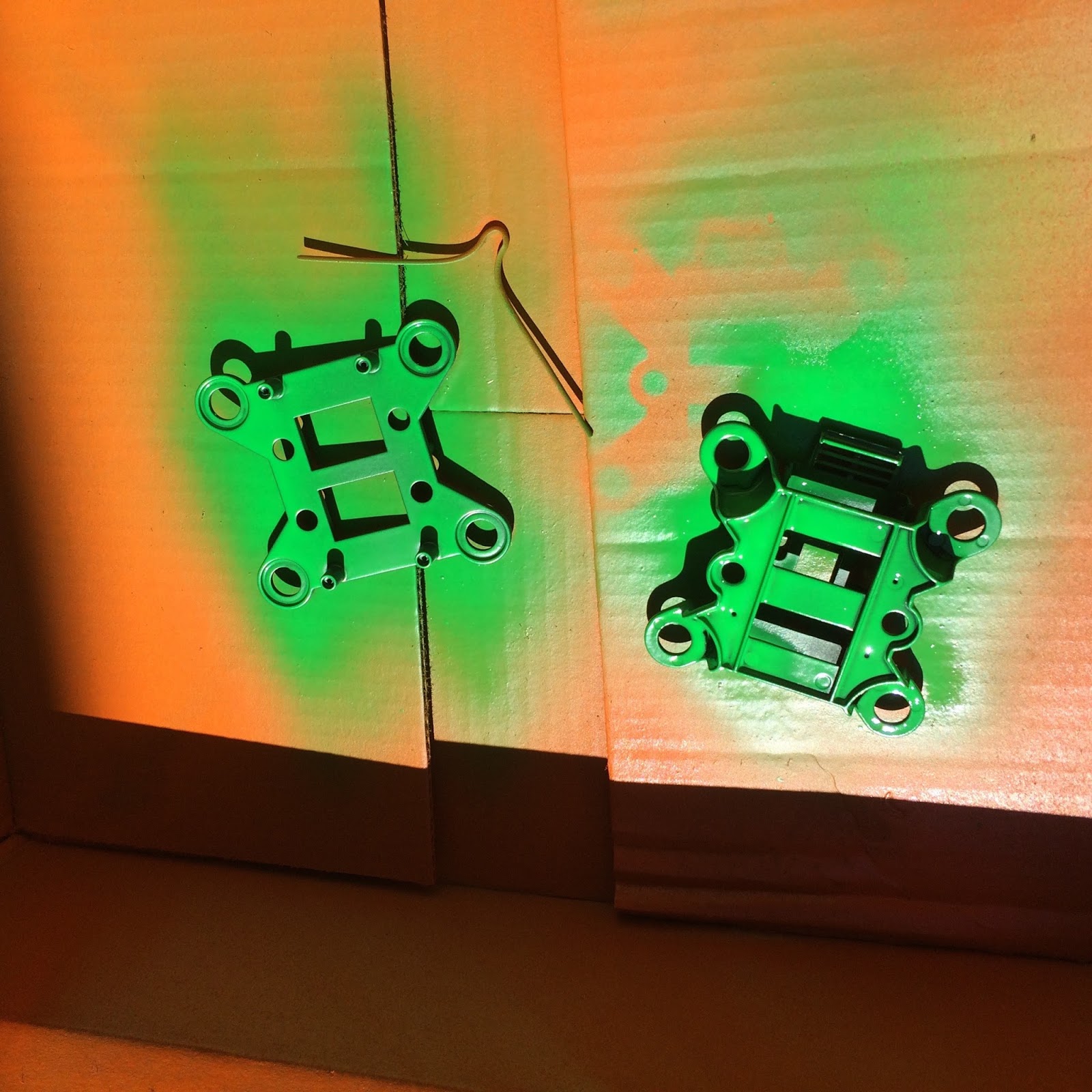
OK, the paint -I shot the frame this morning with the Orange and think I'm going to hit the front or back with a day-glo green for a little assistance with visual orientation as it's VERY hard to see it in black with it being so thin and small.
OHH Orange!!
Orange and green clash nicely!!
Now let's get into the build...
1st off -
The Parts I'm using here are as much from the Tarantula as I can, well, because I have them. All electronics are off the Tarantula as well as the motor mounts, gears, motors and props and even 90% of the screws.
The WLToys V262/V666 parts are listed...
one body (WLtoys V262 V333 V666 RC Quadcopter Spare Parts Main Frame)
one battery box (Spare V666 - 03 Battery Box Fitting for Wltoys V666 RC Quadcopter)
Really that's all you need. I did add the anti vibe camera mount as I want to carry my RunCam HD on it.
Anti Vibration Camera Mount (Spare Anti - Vibration AB Fitting for Wltoys V666 RC Quadcopter)
Anti Vibe Balloons (Damping Ball Fitting for Wltoys V666 RC Quadcopter)
It seems now you can purchase it as a whole anti vibe/camera mount unit but when I ordered they only came separate. Also the little screws and washers for the separation prevention safety were just stuff I had laying around as they didn't come with it.
Assembly of the frame is pretty straight forward. Slide the arms in the body, make sure they are seated then slide the motor mounts over the ends of the arms. The Tarantula motor mounts slide over the V262 carbon arms snuggly, down right perfect, almost like they were made to be used that way.. (hummmm, shared mold maybe? ;) )
(Click images to enlarge)
Some minor issue, the carbon arms I used have no holes or anything drilled in them and the Tarantula's motor mounts are held by the body halves studs screwed together holding it, nothing is actually screwed to the mount it's self, it's just pinched between the Tarantula shell.
For the body to arm mounting, the screws thread into the body so I just used some square point screws (no actual point to make a hole and crack the carbon) and pinched it lightly. worked awesome. For the arms to X6's motor mounts attachment I drilled a very small hole in each arm right where the stud in the Tarantula's body went through. screwed a small screw in that fit just inside the stud hole in the mount. Simply, it prevents the mount from sliding off the arm. I put a few drops of crazy glue in and around the hole to help prevent the carbon from cracking. (works great as the whole motor mount broke during a major crash last night so it's sure not coming off)
(Click images to enlarge)
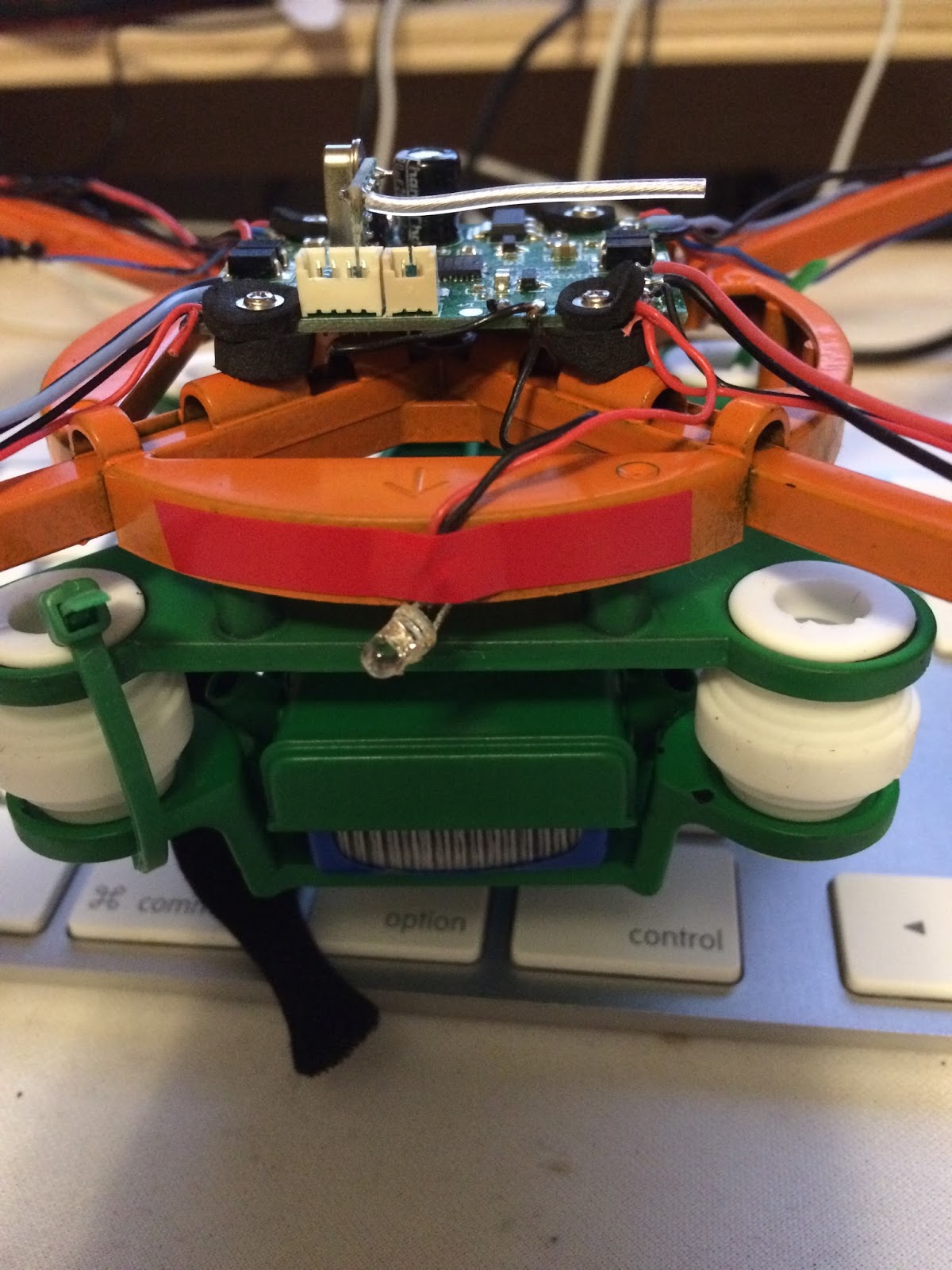
The battery box is just screwed to the under side of the frame where there are 4 studs. If using the camera anti vibration mount the battery box screws to it. The battery adds weight to the dampening system as the camera it's self aren't usually enough weight to activate the balloons.
Electronics are also pretty easy to get setup with one exception (which is kinda a major one) the Flight Control Board.
I was REALLY careful with orientation of all the wiring so I wouldn't get the thing flying sideways or have issues with LED's or the battery cable. I detached everything from the Tarantula but left it all in the shell so as not to turn anything around or get something upside down. I mounted up the motors, gears and props on the new frame more so I could flip it over and not worry about the FC board getting squished. The amount they get in the way is minimal and the protection of the top of the FC board is worth the little annoyance. When it was time to install the FC and wiring I just put them side by side, picked it up out of the Tarantula body and plopped it on the V262 frame.
Only issue I had as I have stated earlier was with the FC board and the mounting studs on the V262 frame are just slightly off. As you can see the screws will actually go through and in, but they are in contact with the edge of the FC Board. I tried it that way and it flew but after a minute of so she'd start to pitch off and need trimming and it would get gradually worse. (almost exactly the same issues reported with bad version #2 FC boards.. wondering if there is an easy fix there?)
Screws are just off the holes in the FC Board
So, I ended up cutting out a small bit of the FC board and used the stock Tarantula board dampeners. I put the fat dampener doughnuts under and the thinner ones on top then used the stock Tarantula screw which have the tiny washer built into the head, I screwed it all down, but not too tight. Holds and flies perfectly. There is a small area the doughnut over laps one of the LED spots on the board but it hasn't cause an issue yet.
Board after knocking out for mounting studs and after dampeners and screws installed
Lastly, I just used a thin piece of electrical tape to hold the wires in place out on the arms. I removed the LED that is normally at the top of the Tarantula and one of the eye ball LED's broke off during mounting and such so I just snipped it's wires and left only one up front which is also held in place with a simple strip of electrical tape to the front of the body. I might drill a small hole in the body there to slip it through later to get a cleaner look, but for now it actually works well.
Lastly are the legs, which I recorded a little video of how I made them. Here's the simple zip tie leg install method I used.
The legs actually work really well and even better than I thought as I had a major crash which broke the motor mount right off the quad. Leg held the mount to the body somewhat and prevented the motor cable from being totally yanked and from the whole chunk being lost.
After crash broken motor mount which leg held from flying away
That's basically it!! transferring the X6 over to a V262 frame really isn't all that hard and MAN the thing is quieter, faster and smoother flying. The best part is I have taken a pretty much destroyed Tarantula and made it totally flyable again with a rather small investment of money and time.
OK, I've seen people talk about all these quadcopter and state something like "micro quad" and "mini quad" or full size quadcopter. But there never seems to be a general consensus on what each "class" covers...
Well, I'm gunna state what I think is a good general rule to cover what each is, at least what makes sense to me... Again, this is very general and there are models that kinda float in-between or have features that usually are in another class.
"NANO-MICRO QUAD"
These are the smallest of the small, mainly lead in the market by the Cheerson CX 10 and the Estes ProtoX.. and a bunch of knock offs from Syma, JJRC and others. These things are tiny, very tiny!! Don't fly around the table at dinner time as these things can fall right inside the average water glass.
If you put 3 of your fingers together they are wider than these things are. FUN!! Pretty much for indoor flight though you can take them outside in low wind. Usually have built in batteries as the extra material to make a battery door, cabling, and plug ends would add too much weight. Most are direct drive propellers that push onto the brushed motor's drive shaft. Most have a very tiny transmitter that are smaller than the Xbox/playstation game pads many people are familiar with.
"MINI QUAD"
These are the little palm size class of quadcopter with the Walker Ladybird being the original market holder but in the last few years seemly dominated by the Hubsan X4 107, lot's of knock off and varieties like the Syma X11, JJRC 1000 and the "Top Selling X6" (yes that is the name of the thing) as well as at least a dozen others. Most are a bit on the "sporty" flight style flying rather quickly. These mostly are a good indoor/outdoor dual use quad as they are small enough to actually fly around in a room but big enough and powerful enough to fight a gentle wind easily. Generally having a game pad style transmitter (pretty much look just like an Xbox or Playstation game pad) all have removable "slip in" single cell batteries that very in size and power and are lipo and of the 3.7volt variety. Most are direct drive like the micro quads and have press on props direct to the brushed motor drive shaft, (only exception I know of is the Syma X11 which is gear driven with screw on props). Many models can come with video cameras built into the bodies, both in SD and HD for a little "home movie" fun. There are a few First Person View quads in the class, but image quality is generally low SD and the equipment is kinda heavy for these small of copters. "MID-SIZED QUAD"
These are the larger, mostly still in the "toy grade" of quadcopter generally around 12" (30 centimeters or so) square. Market is highly dominated by the Syma X5 with many down right copy cats of the looks. There are an abundance of others also in the last year or so like the JJRC X8 and many of the "department store" models out there. Many have cameras in little external cases. Not as "spunky' as those in the smaller classes do to their larger size and gear drive. This size is the mixing point between the toy grade brushed motors and the much higher quality, brushless motors. Most of the popular "Racing 250/350" First Person View (FPV) are in this size class and are mostly the starting point for custom built units. This is also the size things like GPS and high end electronics start coming really into play.
"FULL SIZED"
These used to be dominated by the $1000 and above Pro-sumer and professional grade DJI and Walker quadcopter, but in the last year there are a bunch of toy grade, around $100, models as well as a decent drop in the Pro-sumer grade models pricing. The new Syma X8 and the new Tarantula X6 are full sized quadcopter that are still in the toy grade for pricing and equipment but are really nice pushing almost into the prosumer grade, though not quite. These still have Brushed motors on the toy grade but the size is pretty much dominated by the brushless motor as you need it for real reliability lifting the weight. Full sized are generally setup to lift fancy, higher end camera equipment and fly longer and often times in the professional arena, are pre-programable to fly a pattern set with GPS software with little or no input from the controller after lift off. This class of quad is what the FAA is most concerned about as they have the power and range to get into the lower air traffic space.
"LARGE QUAD/DRONE"
Usually military grade carrying munitions like big guns, lasers, missiles or all the above. If you see one flying over you? you should probably hide!!
here's a video with both the stock lens and after screwing in the after market wide angle lens.. Think I need to do a bit more focusing, (or I might have gotten a finger print on it.) but it's more stable to watch video for sure.